

Pilates Rehab vs Traditional Exercise for Recovery

A sore shoulder during overhead presses, a knee that complains on stairs, or low back stiffness after a long workday can make exercise feel like a negotiation. The question behind pilates rehab vs traditional exercise is not which method is better in every situation. It is which type of movement helps you restore control, build capacity, and return to the activities that matter to you.
For many active adults, the best answer is not an either-or choice. Pilates-based rehabilitation and traditional exercise can serve different roles at different points in recovery. Knowing the difference helps you make progress without losing sight of your larger goal: a body that is ready for work, family, training, sport, and everyday life.
What Pilates Rehab Is Designed to Do
Pilates rehab is not simply taking a group Pilates class while recovering from an injury. It is a clinical, individualized approach that uses Pilates principles and equipment to improve movement quality, strength, mobility, breathing, coordination, and body awareness.
A physical therapist may use the reformer, Cadillac, chair, mat work, and other tools to adjust resistance and position your body in ways that are appropriate for your current ability. The work can be highly specific. Someone recovering from hip pain may need to learn how to control pelvic motion during a single-leg task. Someone with shoulder irritation may need to regain upper-back mobility and shoulder blade control before loading pressing movements.
The value is in the precision. Pilates-based rehab often slows movement down enough for you to notice where you compensate, brace unnecessarily, shift away from one side, or lose control. That feedback can be especially useful after pain, surgery, an extended break from exercise, or a recurring issue that has made you hesitant to move normally.
What Traditional Exercise Brings to Recovery
Traditional exercise includes familiar training methods such as strength training, cardiovascular exercise, free weights, machines, resistance bands, running, cycling, and bodyweight movements. Its primary advantage is that it can build the physical capacity required for real life and recreation.
If you want to carry groceries comfortably, play tennis, run a 10K, lift your child, or return to a demanding gym routine, you eventually need enough strength, endurance, power, and tolerance for those demands. A carefully programmed squat, deadlift, row, press, step-up, or loaded carry can be an excellent part of rehabilitation when the exercise matches your current abilities.
Traditional exercise is also highly scalable. A movement can begin with bodyweight, progress to light resistance, and gradually become more challenging through load, range of motion, speed, volume, or complexity. The key is not choosing the most advanced variation. It is choosing the variation that creates a useful training effect while your technique and symptoms remain manageable.
Pilates Rehab vs Traditional Exercise: The Real Difference
The main distinction is often the immediate emphasis. Pilates rehab tends to prioritize movement options, alignment, control, and targeted strength in lower-load settings. Traditional exercise tends to emphasize progressively building the strength and conditioning needed to meet larger functional or athletic demands.
That distinction matters, but it should not be overstated. Pilates can be challenging and strength-focused. Traditional exercises can be taught with exceptional attention to technique. Neither approach is automatically gentle, hard, corrective, or performance-oriented. The quality of the plan depends on the person, the clinician or coach, and the goal.
Consider a recreational runner with persistent hip discomfort. Pilates-based work may help them improve trunk and hip control, access motion that feels restricted, and identify habits that affect their stride. Traditional strength training may then help them build the single-leg strength, calf capacity, and overall conditioning that supports a return to mileage. The runner does not need to pick a side. They need a progression that respects both movement quality and the demands of running.
When Pilates-Based Rehab May Be the Better Starting Point
Pilates rehab can be particularly helpful when you feel disconnected from your body or unsure how to move after an injury. It may be a strong starting point if pain has caused you to guard, if you have difficulty controlling a joint through its available range, or if standard gym exercises feel awkward before they feel challenging.
It can also work well for people who spend long hours sitting and want a structured way to rebuild mobility and strength without jumping immediately into high-load training. A busy professional may not need more random exercise options. They may need focused coaching that helps them understand how to move with intention and confidence.
That said, starting with Pilates-based rehab does not mean staying there indefinitely. If your goal includes hiking, lifting, court sports, running, or returning to the gym, your program should evolve toward the specific demands of those activities.
When Traditional Exercise Should Take a Larger Role
Traditional exercise becomes increasingly important as your tolerance improves and your goals become more demanding. If you need to sprint, change direction, lift heavy objects, climb stairs without fatigue, or tolerate long days on your feet, low-load control work alone may not prepare you fully.
Progressive resistance training is one of the clearest ways to build durable capacity. It gives muscles, tendons, bones, and the cardiovascular system a reason to adapt. This does not require maximal lifting or an aggressive program. It requires consistency, appropriate dosage, and a plan that advances as you get stronger.
For some people, traditional exercise can also be the better starting point. A person with a straightforward deconditioning issue who moves well and has no significant limitation may benefit more from a simple, well-designed strength and walking program than from highly specialized work. Personalized care means using the right tool, not making every problem fit one method.
A Strong Recovery Plan Uses Both
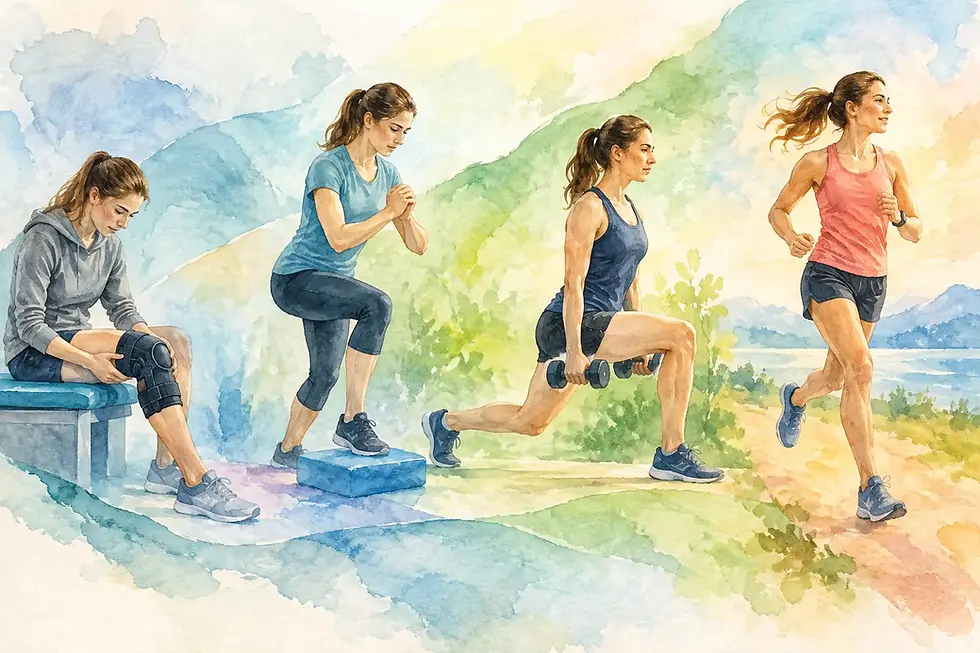
The most effective rehabilitation plans often blend Pilates-based principles with traditional strength and conditioning. Early on, that may mean using Pilates equipment to find comfortable movement, improve control, and build tolerance in targeted areas. As confidence grows, the plan can introduce squats, hinges, carries, rowing, cycling, and sport-specific drills.
At Reef Physical Therapy in Long Island City, this bridge matters because recovery should not stop when pain is less noticeable. The goal is to help people move from treatment to training and from training back to the activities that make them feel like themselves. A full Pilates studio and strength and conditioning environment make it easier to progress without treating rehabilitation and fitness as separate worlds.
Progress should be measurable, even if the measures are simple. You may notice that stairs feel easier, your shoulder reaches farther, your walking pace improves, or you can complete a workout without needing extra recovery time. Those changes matter because they reflect a growing ability to handle the life you want to live.
How to Choose the Right Starting Point
Start by defining what you want to get back to. “I want to exercise again” is a meaningful goal, but it becomes more useful when it is specific: return to deadlifting, play pickleball twice a week, carry a toddler without back stiffness, or train for a spring race.
Then consider your current starting point. Are you limited more by pain, mobility, coordination, strength, endurance, or uncertainty? Do certain movements trigger symptoms, or do you mainly feel out of shape? Your answers can guide the first phase of training.
A good clinician will also look beyond the painful area. Knee pain may involve hip and ankle strength, training volume, footwear, recovery habits, or how you control a single-leg landing. Shoulder discomfort may be influenced by neck position, thoracic mobility, pressing technique, and total workload. That wider view creates a more useful plan than simply avoiding the movement forever.
You do not need perfect movement before you earn the right to get stronger. You also do not need to push through every uncomfortable sensation to prove that you are committed. The productive middle ground is learning what your body can do today, then giving it a clear reason to adapt tomorrow.
Build a Body You Can Trust
The best exercise approach is the one that meets you where you are and keeps moving you forward. Pilates rehab can help you reconnect with movement. Traditional exercise can help you develop the strength and endurance to use that movement in the real world. Together, they can support a more confident return to the things you enjoy.
Choose a plan that makes you an active participant in your progress. Small, well-guided steps taken consistently can rebuild more than fitness - they can help you take full control of your body and keep investing in the active life ahead.


Comments