

8 Best Strength Exercises for Beginners to Start

The best strength exercises for beginners are rarely the flashiest ones. They are the movements that help you stand up from the floor with control, carry groceries without thinking twice, climb stairs with more confidence, and return to the activities you enjoy. For busy New Yorkers balancing work, family, and a full calendar, strength training should build capacity for real life, not add another complicated obligation.
A good beginner program does not require you to feel exhausted after every session. It requires a clear starting point, consistent practice, and movements that can progress as your strength, coordination, and confidence improve. The goal is not to copy someone else's workout. It is to take full control of your body, one well-executed repetition at a time.
What makes a strength exercise beginner-friendly?
Beginner-friendly does not mean easy or ineffective. It means the exercise can be adjusted to your current ability while still teaching a useful movement pattern. The best choices usually train one of the major ways your body moves: squatting, hinging, pushing, pulling, carrying, and stabilizing.
An exercise is a strong place to start when you can keep your breathing steady, maintain control through the full range you currently have, and repeat it without sharp or worsening pain. You should feel challenged, but not rushed or overwhelmed. If a movement causes symptoms that persist or change the way you move for the rest of the day, scale it back and consider getting individualized guidance.
At Reef Physical Therapy, this is where the assessment matters. Two people may both be “beginners,” but one may need to build ankle mobility before squatting deeper, while another may be ready to add load right away. The movement pattern stays valuable. The entry point changes.
The best strength exercises for beginners
1. Sit-to-stand or box squat
The sit-to-stand is one of the most practical lower-body exercises available. Sit on a stable chair or bench with your feet about hip-width apart. Lean your torso slightly forward, press through your whole foot, and stand tall. Slowly lower yourself back to the seat with control.
This exercise develops the legs, hips, and trunk control needed for everyday tasks. It also gives you a clear depth target, which can make squatting feel more approachable. As it becomes easier, use a lower surface, pause just above the chair, hold a light weight close to your chest, or progress to a goblet squat.
2. Hip hinge with a dowel or light weight
The hip hinge teaches your hips to do their share of the work when you bend, lift, and pick things up. Start standing with soft knees. Push your hips back as if you are reaching toward a wall behind you, keeping your spine long and your weight balanced through your feet. Then drive through the floor to return to standing.
Many people confuse a hinge with a squat. In a squat, the knees travel forward more and the torso stays relatively upright. In a hinge, the hips travel farther back and the torso tips forward. Learning both patterns can reduce the tendency to rely on one area of the body for every task. Once the bodyweight version feels consistent, a light dumbbell Romanian deadlift is a useful next step.
3. Glute bridge
Lie on your back with knees bent and feet flat on the floor. Exhale gently, press through your feet, and lift your hips until your trunk and thighs form a comfortable line. Pause briefly, then lower under control.
Glute bridges strengthen the hips without requiring much balance or equipment. They can be particularly helpful for people who spend long periods sitting and want to reconnect with their hip muscles before progressing to more demanding lower-body work. Avoid forcing your hips high enough to arch your low back. A controlled range is more useful than a dramatic one.
4. Incline push-up
Push-ups are not an all-or-nothing test. An incline push-up, with your hands on a sturdy countertop, bench, or bar, lets you train the same pushing pattern with a manageable amount of body weight. Keep your body in one long line, bend your elbows as your chest moves toward the surface, then press away.
The higher the surface, the easier the movement generally becomes. As your control improves, lower the height of the support. This is often a better progression than forcing floor push-ups with a shortened range or sagging trunk. Your chest, shoulders, triceps, and core all work together here.
5. Dumbbell row or band row
Pulling strength supports posture, shoulder function, and everyday lifting. For a supported dumbbell row, place one hand on a bench or stable surface, hinge at the hips, and pull a dumbbell toward your lower ribs. Keep your neck relaxed and avoid twisting your torso to get the weight up.
A resistance-band row is another accessible option, especially at home. Think about drawing your shoulder blade back and down as you pull rather than shrugging toward your ears. If you sit at a desk for much of the day, rows can be a valuable counterbalance to the amount of time your arms spend in front of you.
6. Split squat with support
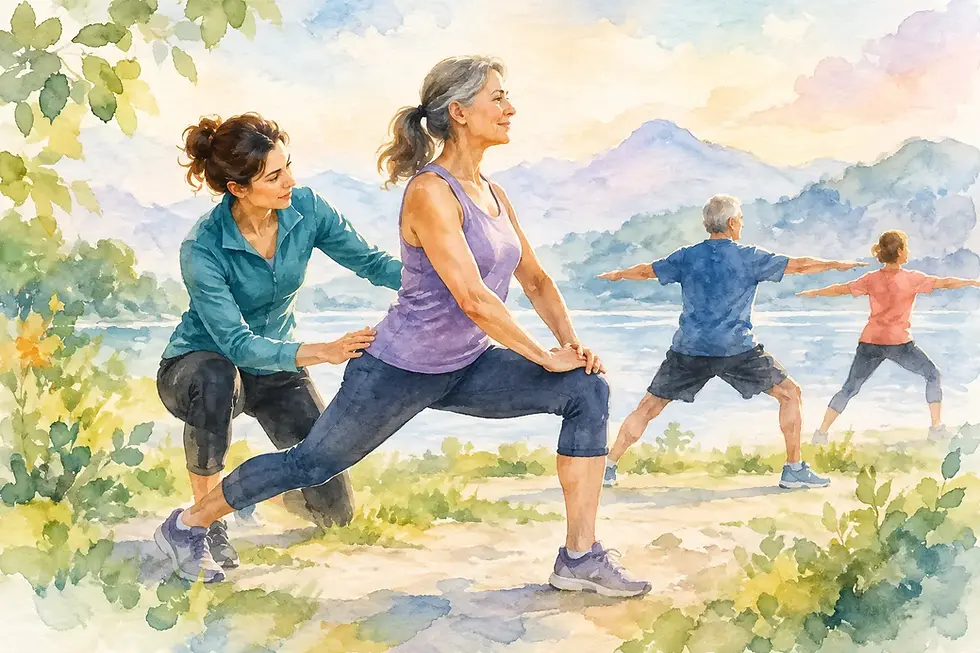
Walking, stair climbing, and many recreational activities require each leg to produce force independently. A supported split squat helps build that capacity. Stand in a staggered stance near a wall, rail, or chair for balance. Lower straight down as far as you can control, then press through both feet to rise.
This can feel demanding quickly, which is normal. Shorten the stance, reduce the depth, or use more hand support if needed. The goal is not to make it look impressive. The goal is to build strength while your knee, hip, foot, and trunk learn to work together.
7. Farmer carry
Carrying weight is one of the simplest ways to train grip, shoulders, trunk stability, and walking mechanics at once. Hold a dumbbell, kettlebell, or grocery bag in each hand, stand tall, and walk slowly for a set distance. Keep your ribs stacked over your pelvis and avoid leaning side to side.
Farmer carries are functional because they resemble life. The right load is one you can carry with steady posture and controlled steps. If both hands are too easy, holding weight on one side can add a greater stability challenge, but start with balanced carries first.
8. Dead bug
Strength is not only about moving more weight. It is also about controlling movement where you need stability. Lie on your back with your hips and knees bent to about 90 degrees and your arms reaching toward the ceiling. Slowly lower one heel toward the floor while reaching the opposite arm overhead, then return and switch sides.
Keep the motion small enough that your low back stays comfortably supported by the floor. Dead bugs teach your trunk to resist unwanted motion while the arms and legs move, a skill that carries over to lifting, running, and daily activity.
How to turn these exercises into a workable routine
Start with two full-body sessions per week on nonconsecutive days. Choose one squat pattern, one hinge or bridge, one push, one pull, and one carry or trunk exercise. Perform two sets of six to 10 controlled repetitions for most movements. For carries, try two short walks of 20 to 40 seconds.
Leave a few repetitions in reserve. You should finish a set feeling that you could likely perform two or three more repetitions with good form. This creates enough challenge to adapt without turning every workout into a recovery problem. As your body adjusts, add a repetition, a little load, a longer carry, or a third set. Change one variable at a time so you can tell what your body responds to well.
Consistency matters more than exercise variety early on. Give a routine four to six weeks before deciding it is not working, unless it is causing persistent symptoms or clearly does not fit your needs. Strength gains often show up first as better control and less effort in daily tasks, then as more weight or more repetitions over time.
Form matters, but perfection is not the standard
Good technique is a moving target, not a fixed pose. Your individual proportions, mobility, training history, and goals all influence how a movement looks. Aim for controlled repetitions, comfortable joint positions, steady breathing, and a range of motion you can own.
Video can be useful, but it cannot replace individualized feedback when pain, an old injury, or uncertainty is holding you back. If you are returning to exercise after time away, working around a limitation, or preparing to get back to a sport, a physical therapist can help identify the right starting dose and progression.
The most useful strength program is the one that earns a place in your week. Start with movements that feel achievable, practice them consistently, and let your progress create momentum. That is how strength becomes more than a workout - it becomes support for the life you want to keep living.


Comments